

Commentary
Rym Momtaz
{
  "authors": [
    "Rym Momtaz"
  ],
  "type": "commentary",
  "blog": "Strategic Europe",
  "centerAffiliationAll": "",
  "centers": [
    "Carnegie Endowment for International Peace",
    "Carnegie Europe"
  ],
  "englishNewsletterAll": "",
  "nonEnglishNewsletterAll": "",
  "primaryCenter": "Carnegie Europe",
  "programAffiliation": "",
  "regions": [
    "Europe",
    "United States",
    "Iran"
  ],
  "topics": [
    "EU",
    "Foreign Policy",
    "NATO",
    "Security"
  ]
}
Source: Getty
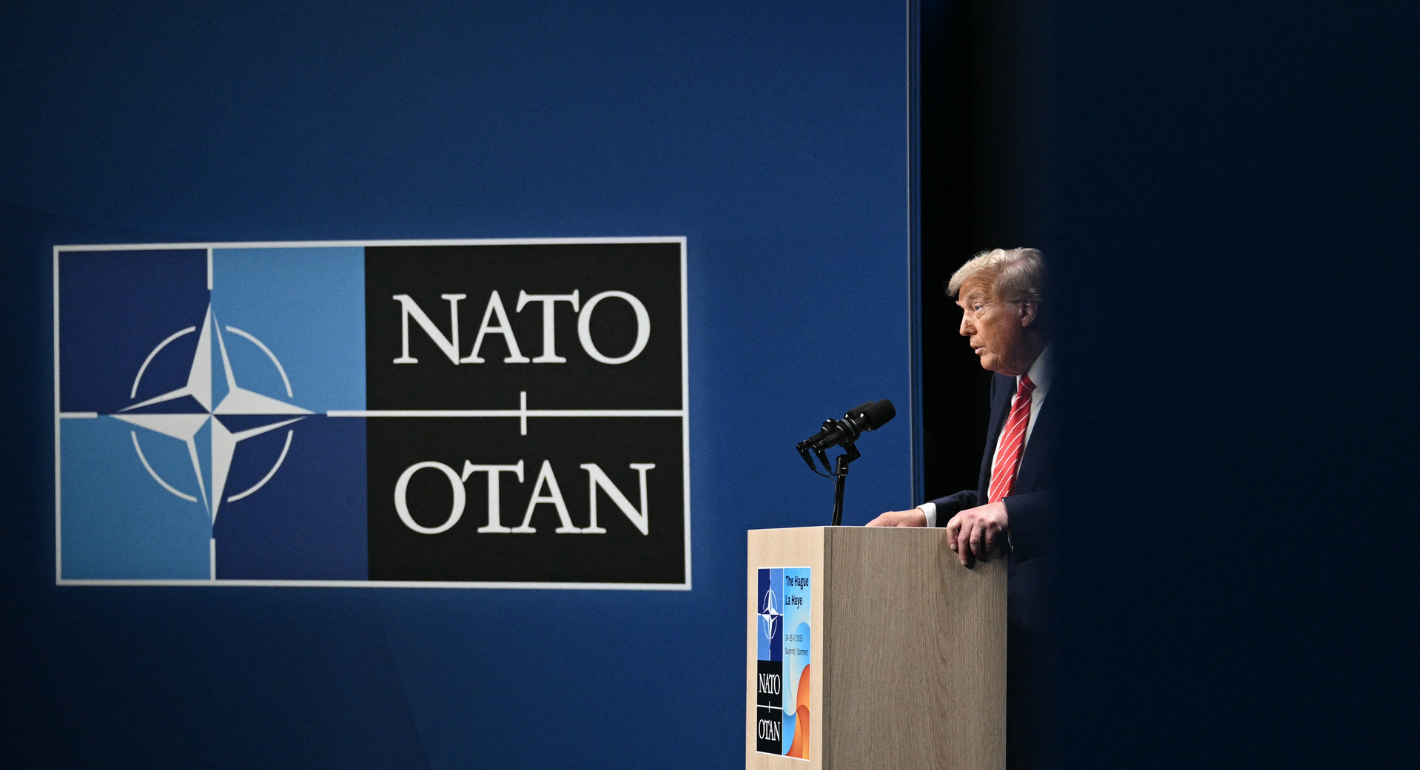
Donald Trump has repeatedly bashed NATO and European allies, threatening to annex Canada and Greenland and deploring their lack of enthusiasm for his war of choice in Iran. Is this latest round of abuse the final straw?
Professor, Institute for Political Studies of the Polish Academy of Sciences, Poland
NATO has already survived an extraordinary series of shocks under the current U.S. administration: Washington siding with Moscow in key UN General Assembly votes on Ukraine, ill‑prepared bilateral dealings with Russia, repeated public wavering on mutual defense under Article 5, open threats to annex Greenland, and now the so-called special operation in Iran. Taken together, these are not one‑off aberrations but a pattern that is steadily eroding the political foundations of the alliance. And we are barely a year into this presidency, with more ruptures almost certain to come.
Whether the alliance survives this period will depend not only on what President Trump does, but equally on how Europeans respond. Will they hold together when confronted with yet another breach of international law by their most powerful ally? Will they have the political capital—and unity—to shape negotiations between Moscow and Kyiv and credibly guarantee Ukraine’s security once a ceasefire is reached? And will they find a coherent line on the Iran war and the wider Middle East to prevent an even larger regional confrontation? NATO may outlive a disruptive U.S. president, but it cannot survive if European governments remain divided, reactive, and strategically voiceless.
Adjunct Senior Fellow, Center for a New American Security
The allies have already crossed a line: Trust in the United States and its commitment to Article 5 have been undermined. There will be no return to business as usual in NATO, during neither this U.S. administration nor the next one. Losing the trust of allies and friends is a tragedy for Washington and was wholly avoidable. Yes, the United States has disagreements with allies and vice versa. There are hard feelings on both sides, aggravated by the harsh rhetoric and bullying tactics of the current occupant of the White House. But the issues that have caused this unhappy relationship can be—and are being—addressed by allies, especially on burden sharing. Hopefully, focused work by European countries to rearm will result in a more equal and respectful transatlantic partnership. However, unquestioning trust will not be part of the relationship—but neither will a Europe dependent on the United States for its defense. That is a good thing, but the loss of trust is a steep price to pay.
Analyst, Stockholm Centre for Eastern European Studies, Swedish Institute of International Affairs
The Iran war is a much-needed geography lesson for the current U.S. administration. Until now, arguments about Europe’s crucial role in the global war on terror were lost on this administration because Trump, Vance, and others thought it was a mistake to begin with. Now, they have gained first-hand experience in conducting military operations in the Middle East. And it turns out that doing so without access to bases in Europe is difficult, no matter who sits in the Oval Office. However, this administration is unlikely to learn from its mistakes and change course on relations with Europe.
U.S. security guarantees to Europe have been at the core of NATO since its founding. But over the course of seventy-seven years, the alliance has become more than that: a structure for military cooperation between European countries. NATO can therefore survive the Iran war—and even a U.S. withdrawal—as European members have an incentive to maintain it, even if in a radically different form. The current work to build a European pillar and the ongoing burden shifting are preparations for this eventuality.
Deputy Director, Centre for European Reform
The fiasco of the war of aggression Donald Trump and Israeli Prime Minister Benjamin Netanyahu are conducting against Iran may not drive Europe completely out of the White House’s orbit, but it will further weaken NATO’s gravitational pull on European allies. Trump did not consult them before his attack, and he has not consulted them on whatever deal with Tehran he is now contemplating. He has done serious damage to Europe’s security and economy—while insulting his allies for not joining in his criminal folly. If, as seems likely, the war ends with Iran controlling the Strait of Hormuz more firmly than it did before, then Europe will feel the impacts in its energy and food security—Asia and Africa even more so. The war has also strengthened Russia’s hand, not least because Trump has relaxed some sanctions on its oil and gas exports, making it harder for Europe to increase the pressure on Moscow to end its war against Ukraine. Europeans will not want to sever their ties with NATO: Its integrated command structure and planning processes are valuable and hard to replicate. But Trump’s Middle East misadventure will motivate them to de-risk from an increasingly erratic ally.
Director, International Centre for Defence and Security
Donald Trump has certainly done irreversible damage to NATO, but the reasons why there is no way back are long-term and structural. U.S. strategic interests have shifted away from Europe. The transatlantic relationship may get more normal after Trump, based on narrower shared interests, respectful communication, and predictability, but Europeans will have to grow up.
The alliance can still survive if Europeans take the lead and use its institutional framework to build up their own credible defense. NATO’s decisionmaking procedures, command structures, and defense plans could gradually be Europeanized. In this process, Europe should develop its own modes of warfare, drawing on the lessons of Ukraine rather than trying to acquire all of the same capabilities that the United States has provided. Obviously, this takes time—and we don’t know how much time Europe has. No one knows how Trump would respond to an attack against a NATO member or what he would demand in return for U.S. action. Frontline countries are strengthening their readiness to fight back on their own if need be, while trying to maintain what is left of the alliance. The rest of Europe has yet to show the same sense of urgency.
Nonresident Scholar, Carnegie Europe
NATO was never going to return to business as usual. The U.S.-Israeli war with Iran—and Donald Trump’s repeated denigration of America’s European allies in the context of that conflict—are only confirmation and not cause. European leaders will continue to work with and through the alliance; they will also continue to court U.S. support in the provision of European security. But they have known that this is not a viable long-term strategy for a while now.
The question is what those European leaders will do about it. Just because Trump is taunting them to take responsibility for the Gulf’s security is no reason for European policymakers to ignore their collective self-interest. If anything, those taunts reflect a recklessness that should give Europeans good reason to hedge their dependence on U.S. oil and gas—and in ways that do not strengthen Russia at Ukraine’s expense. This is not an easy calculus to make, let alone to sell to voters. Nevertheless, it is the kind of difficult choice that must be faced in a world increasingly defined by competitive and conflicting expressions of strategic autonomy. It will take time for European leaders to get accustomed, perhaps, but their muscles will strengthen with use.
Associate Professor, Department of Public Administration and International Affairs of Syracuse University
The answer to that question depends largely on how one defines "survive."
If survival is understood in purely institutional terms, then NATO's near and medium-term prospects are reasonably strong. The mechanisms of the alliance are unlikely to collapse within weeks or even months.
However, if survival is measured by allies maintaining genuine mutual trust, sharing a common strategic vision, and demonstrating a credible willingness to engage collectively, then the question of NATO's long-term viability becomes considerably more uncertain.
The Iran war is, in this sense, only the most recent stress test. The deeper challenge is the cumulative weight of the Trump administration's posture toward its own allies. By treating transatlantic interdependence as a lever of coercion rather than a foundation of shared security, Washington has confronted Europe with a strategic dilemma it can no longer defer. European capitals must now choose between continuing to accommodate an ally of uncertain reliability and accelerating the development of an autonomous defense capability.
On balance, NATO will likely persist as a political forum and venue for transatlantic dialogue. But the more consequential trend over the coming years may be a quiet yet deliberate shift away from the alliance as the organizing principle of European defense.
Subscribe to Strategic Europe, delivered to you weekdays!

Editor in Chief, Strategic Europe
Rym Momtaz is the editor in chief of Carnegie Europe’s blog Strategic Europe. A multiple Emmy award-winning journalist-turned-analyst, she specializes in Europe and the Middle East and the interplay between those two spaces.
Recent Work
Rym Momtaz
Rym Momtaz, ed.
Carnegie does not take institutional positions on public policy issues; the views represented herein are those of the author(s) and do not necessarily reflect the views of Carnegie, its staff, or its trustees.
Donald Trump’s repudiation of NATO goes against the Make America Great Again vision of a U.S.-centered foreign policy. If the goal is to preserve the alliance by boosting Europe’s commitments, leaning into France’s vision is the most America First way forward.
Rym Momtaz

Hungarians head to the polls on April 12 for an election of national and European consequence. Three different outcomes are on the cards, each with their own implications for the EU.

Zsuzsanna Szelényi
The far right failed to win big in France’s municipal elections. But that’s not good news for the country’s left wing, which remained disunited while the broader right consolidated its momentum ahead of the 2027 presidential race.

Catherine Fieschi
Donald Trump has demanded that European allies send ships to the Strait of Hormuz while his war of choice in Iran rages on. He has constantly berated NATO while the alliance’s secretary-general has emphatically supported him.
Rym Momtaz, ed.
The EU is structurally incapable of reacting to today’s foreign policy crises. The union must fold the EEAS into the European Commission and create a security council better prepared to take action on the global stage.

Stefan Lehne